
The comic tends to come before the actor. And one of the perils of transitioning from comedy to drama (beyond that cumbersome, self-justifying phrase, “comic actor”) is that when you strike upon a memorable character, the “comic” will retain precedence. Art and artist merge, the mask comes to fit the face, and even very talented figures find themselves unable to range on to new terrain, the comic hopelessly elided with the character. In The Trip, when playing a fictionalised version of himself, Steve Coogan didn’t have to give a name to the “albatross around my neck”. The success of Fawlty Towers, John Cleese later wrote, found him forever related to and even equated with Basil Fawlty, forced to forge a specialism in similar, stressed, suited characters (Clockwise, A Fish Called Wanda, Q in the Bond films).
Even more than his predecessors, Ricky Gervais is an encumbered talent. But the corpse he’s stitched to isn’t called David Brent. It’s called Ricky Gervais. Because ever since The Office, in which Gervais gave one of the great comic performances of the century, he effectively retired from acting, and fell back on a sort of autofiction. He played an ambitious scriptwriter in Extras. He played an angry atheist in The Invention of Lying. He has annually played a self-loathing celebrity on the stage of the Golden Globes. And, in After Life, he played a frustrated misanthrope. These must have been easy roles to assume: they are all manifestations of his personality. And they are united by features that run deeper than typecasting, not least Gervais’s voice – the easily attained falsetto, that accent (hailing from somewhere west of Bracknell), the tics (“summat”, “fuckin’ ’ell”, uninhibited talk of “c***s”).
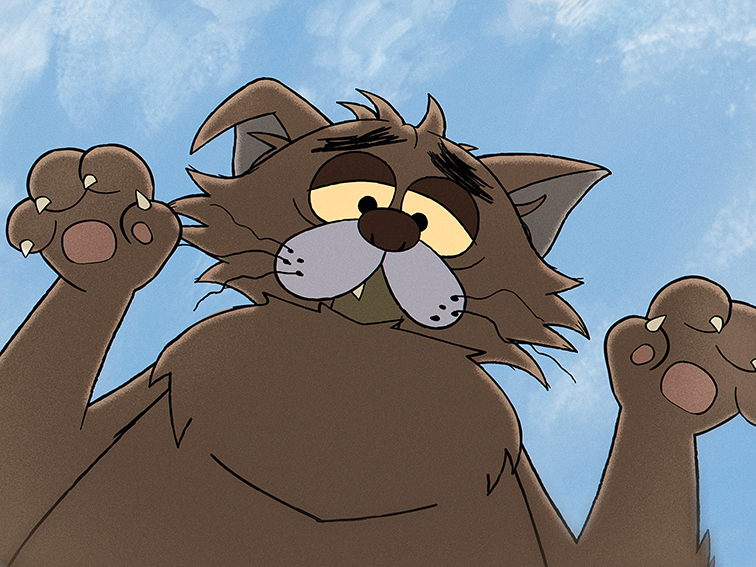
These habits are fixed, even when Gervais gives his voice to a fat, speckled marmalade cat, as he does in the animated comedy Alley Cats. And Alley Cats has a good claim to be the worst project Gervais has worked on. It is shaming and revealing that he is also credited as creator and writer (the dialogue is apparently partially improvised, and sounds like it). It is evidence of an ever decreasing and ever narrowing artistic spiral, one that will deposit Gervais at a coarse, cackling, blokey dead-end.
The Alley Cats are four tramp-like cats who live in an abandoned shack, watching TV, eating and arguing. They are sometimes joined by a local house cat – who unlike them is collared and spayed – whom they call Ponce, but is really named Rupert. When he asks them to use his real name, he triggers one of Alley Cats’s great outbreaks of wit: if he wants to be called Rupert, it’s going to be “Rupert the C***, Rupert the Cocksucker or Rupert the Kiddie Fiddler”. This is the level of conversation between the cats: idle, boorish and puerile, like watching an all-male American podcast. There is a plot of the thinnest sorts – the gang of cats pick up a stray kitten, and try to return it to its owners. And it’s not all quite as profane – there’s an enlightening conversation between the cats, for instance, about whether four elephants could beat a lion in a fight. But some of it is much worse, including excursions into the sex lives of the cats, which involve hedgehogs and fish and would make me feel dirty to write down.

There are a couple of decent jokes about the cats being cats – they’re scared of cucumbers, for instance. But there are plenty more bad ones. And, in what has become a nagging refrain of Gervais’s comedies, the cats are used as mouthpieces for some pretty banal philosophising and larger truths. Such as this tautology: “People don’t care about anything except themselves. They don’t even care about each other, to be honest.” And this, on finding comfort in death: “In a way you do live forever because we live on in the memories of the friends and family that knew us.” A latter-day Aesop, indeed.
Cats and philosophy can share the sleeping mat – for the second time this year, I recommend John Gray’s Feline Philosophy. But in this context, lines like these feel like attempts to rescue Alley Cats from the midden of extremity and banality that has marked Gervais of late.
[Further reading: Luton, mon amour]
Content from our partners


Related

Join the debate
Subscribe here to comment